1. Introduction
Few dashboard warnings create as much anxiety as the check engine light. It can appear during a normal commute, right after you start the car, or even days after you fueled up. Sometimes the car seems to run fine; other times it feels noticeably different. The important thing to know is that this light is not a “guess”—it’s your vehicle’s computer telling you it has detected something outside the normal range. That “something” could be minor, or it could be serious, and your next steps depend on the type of warning and what you notice while driving.
Recommended Tool: Professional OBD2 Scanner
Recommended Tool: Portable Jump Starter
Recommended Tool: Cooling System Diagnostic Tools
🔧 Recommended Professional Tool
Cooling System Diagnostic ToolsProfessional coolant tester and infrared thermometer for accurate overheating diagnosis.
✔ Recommended by automotive technicians ✔ Suitable for BMW, Mercedes, VAG & JLR platforms ✔ Fast international shipping
2. Causes
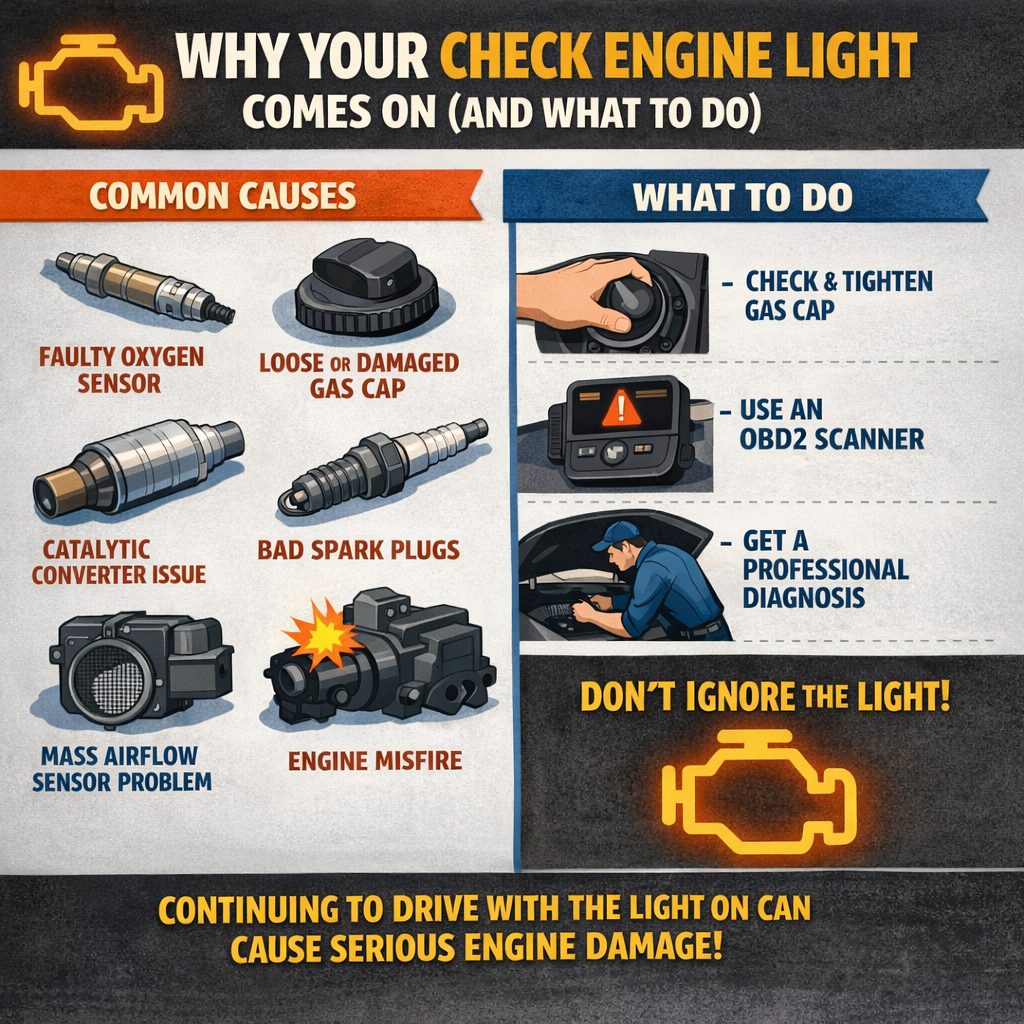
Your car’s engine computer (often called the ECU) monitors sensors throughout the engine and emissions system. When it detects a problem that could increase emissions or harm the engine, it stores a diagnostic trouble code (DTC) and turns on the check engine light.
Common causes (often simple)
- Loose or faulty gas cap
- A loose cap can let fuel vapors escape, triggering an emissions leak code.
- Failing oxygen (O2) sensor
- These sensors help manage fuel mixture. When they fail, fuel economy and emissions can suffer.
- Worn spark plugs or ignition coils
- Misfires are a frequent reason for the light. Ignition issues can start small and worsen quickly.
- Mass airflow (MAF) sensor problems
- A dirty or failing MAF sensor can cause rough running, hesitation, or poor mileage.
- Vacuum or EVAP system leaks
- Small leaks in hoses or the EVAP system (which controls fuel vapors) commonly trigger the light.
More serious causes (can lead to damage)
- Catalytic converter issues
- The catalytic converter reduces harmful exhaust emissions. Problems here can be expensive and may be caused by untreated misfires.
- Fuel system problems
- Low fuel pressure, clogged injectors, or a failing fuel pump can cause lean/rich conditions and misfires.
- Engine timing or mechanical issues
- Less common, but certain codes can point to timing chain/belt issues or internal engine problems.
- Overheating-related faults
- Cooling system problems may trigger codes and can cause major engine damage if ignored.
3. Symptoms
The check engine light can come on with no obvious changes, or it can be accompanied by clear symptoms. Pay attention to what the car is doing, because those clues help you decide how urgent the situation is.
What you might notice
- No noticeable change
- Common with small EVAP leaks or an aging sensor.
- Rough idle or shaking
- Often related to misfires, vacuum leaks, or fuel delivery issues.
- Hesitation or lack of power
- Can indicate airflow sensor problems, fuel issues, or ignition problems.
- Poor fuel economy
- Frequently tied to oxygen sensors, MAF sensor issues, or running too rich.
- Hard starting or stalling
- Could be fuel pressure, crank/cam sensor issues, or ignition problems.
- Unusual smells
- A sulfur/rotten-egg smell may point to catalytic converter issues; raw fuel smell can indicate misfires or fuel system leaks.
Steady vs. flashing check engine light
- Steady light: Usually indicates a fault that should be addressed soon, but you can often drive carefully in the short term.
- Flashing light: Commonly indicates an active misfire that can damage the catalytic converter quickly. Reduce speed and load, and plan to stop driving as soon as it’s safe.
4. How to diagnose
You don’t need to be a mechanic to take smart first steps. A little information gathering can prevent unnecessary worry and help you avoid paying for guesswork.
Step 1: Check how the car is behaving
Ask yourself:
- Is the light steady or flashing?
- Is the engine running rough, lacking power, or stalling?
- Any strange noises, smells, or overheating?
If you notice severe symptoms (especially a flashing light), treat it as urgent.
Step 2: Do a quick gas cap check
This sounds too simple, but it’s common:
- Turn the car off.
- Remove the gas cap and reinstall it until it clicks.
- Check the rubber seal for cracks or damage.
If the cap was loose, it may take a few drive cycles for the light to turn off on its own.
Step 3: Read the code with an OBD-II scanner
Most vehicles 1996 and newer support OBD-II. Options:
- Parts stores often read codes for free.
- Basic OBD-II scanners are inexpensive and plug in under the dash (usually near the steering column).
- Bluetooth scan tools paired with a phone app can also read codes.
Write down:
- The code (example: P0301)
- Any description provided
- Whether it says “pending” or “confirmed”
Step 4: Interpret the code carefully
A code is a starting point, not a guarantee. For example:
- P0300–P0308 often relate to misfires (random or specific cylinder).
- P0420 frequently points to catalytic converter efficiency (but can be caused by misfires or O2 sensor issues).
- EVAP leak codes can be caused by a cap, hose, or valve.
If you’re unsure, look up the code with your vehicle’s make/model/year, but avoid assuming the first part listed is the definite fix.
5. How to fix
The right fix depends on the root cause. Some fixes are owner-friendly; others are better left to a professional.
Owner-friendly fixes (often low risk)
- Tighten or replace the gas cap
- If the seal is cracked or the cap won’t click, replacement is usually inexpensive.
- Replace engine air filter
- A clogged filter can contribute to airflow issues and poor mileage.
- Check for obvious disconnected hoses
- If you see a vacuum hose hanging loose near the engine (and you’re confident where it goes), reconnect it.
- Battery reset (with caution)
- Disconnecting the battery can clear codes, but it also erases learned settings and won’t fix the underlying problem. The light may return quickly. Use this only after repairs, or follow your scanner’s clear-code function.
Repairs that often require more tools or experience
- Spark plugs/ignition coils
- Misfires are common; plug access varies widely by vehicle.
- O2 sensor or MAF sensor replacement
- Requires correct part selection and sometimes special sockets.
- EVAP diagnosis
- Finding small leaks may require a smoke test.
- Catalytic converter replacement
- Expensive and often misdiagnosed if underlying causes (like misfires) aren’t corrected first.
After any repair, the computer may need time to run “readiness monitors.” This means the light may not shut off immediately even if the problem is resolved, or it may shut off after a few normal trips.
6. Prevention tips
Many check engine light issues are preventable with basic habits and routine maintenance.
- Tighten the gas cap every fill-up
- Make sure it clicks and the seal looks healthy.
- Follow the maintenance schedule
- Spark plugs, filters, and fluids matter more than most people realize.
- Use quality fuel
- Consistent fuel quality can reduce deposits and drivability issues.
- Address small symptoms early
- A minor misfire today can turn into catalytic converter damage later.
- Don’t ignore overheating
- If the temperature gauge climbs or you get an overheating warning, stop and investigate.
- Fix oil leaks and vacuum leaks promptly
- Leaks can damage sensors, hoses, and wiring over time.
7. When to see a mechanic
Some situations call for professional diagnosis right away, especially when continued driving could cause damage or create a safety risk.
See a mechanic (or arrange a tow) if:
- The check engine light is flashing
- The car is shaking, misfiring, or losing power
- You notice stalling, hard starting, or strong fuel smells
- The engine is overheating or you see steam
- You have a code related to catalytic converter efficiency along with drivability issues
- The same code returns soon after clearing it or after a simple fix (like tightening the gas cap)
- You’re due for an emissions test and the light is on (a stored code will typically fail the test)
A good shop will confirm the problem with proper testing (not just code reading), explain what failed and why, and prioritize repairs based on urgency. If you come in with your observed symptoms and the codes you pulled, you’ll usually save time—and you’ll be more confident you’re fixing the real issue, not just the warning light.