1. Introduction
An engine misfire happens when one or more cylinders in your engine don’t fire correctly. Modern engines are designed to run smoothly and efficiently, so even a small misfire can feel noticeable and, if ignored, can lead to bigger problems. Misfires can be occasional (only under certain conditions) or constant, and the causes range from simple maintenance issues to more complex fuel or sensor problems. Understanding what triggers misfires helps you respond quickly, protect your engine, and avoid expensive repairs.
Recommended Tool: Professional OBD2 Scanner
Recommended Tool: Cooling System Diagnostic Tools
Recommended Tool: Transmission Diagnostic Tools
🔧 Recommended Professional Tool
Cooling System Diagnostic ToolsProfessional coolant tester and infrared thermometer for accurate overheating diagnosis.
✔ Recommended by automotive technicians ✔ Suitable for BMW, Mercedes, VAG & JLR platforms ✔ Fast international shipping
2. Causes
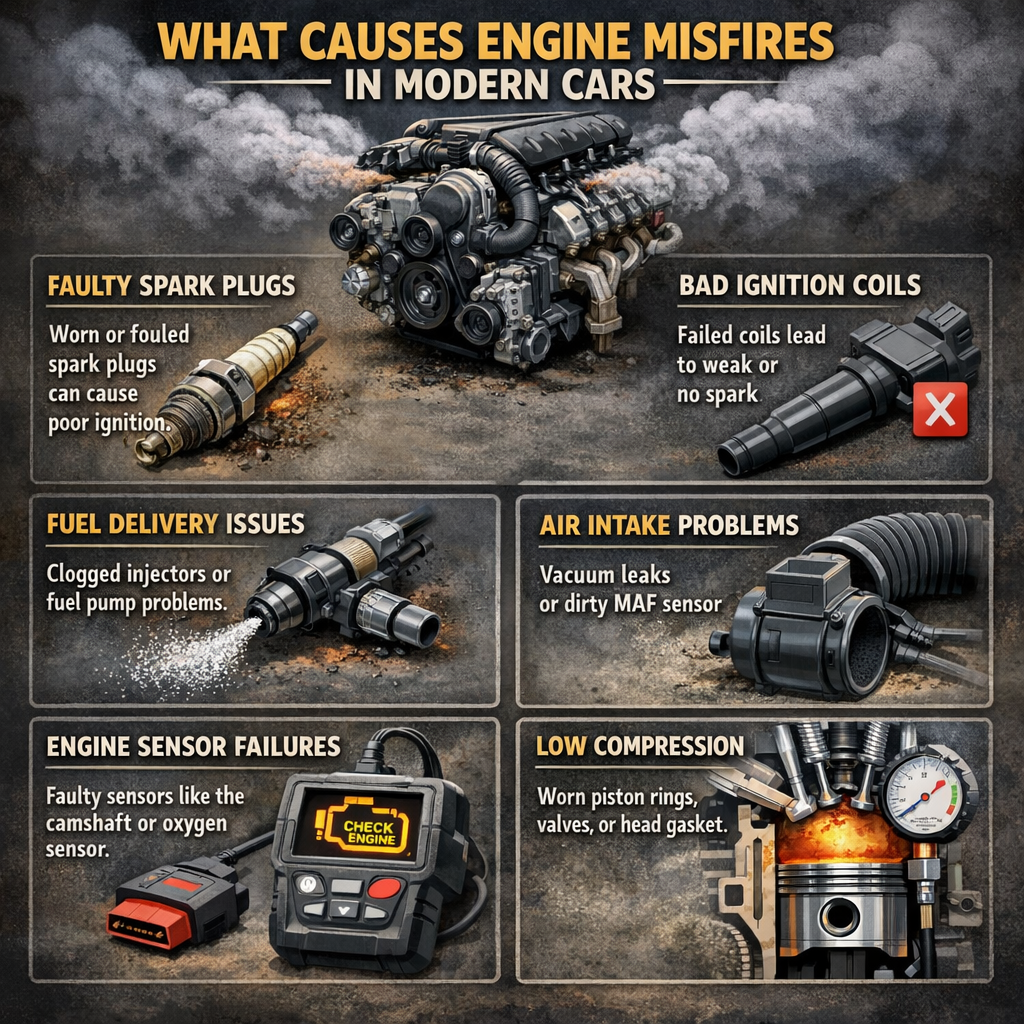
Modern cars rely on three basics for each cylinder: spark, fuel, and compression—plus correct timing and airflow. A misfire occurs when any of these are missing or out of balance.
Ignition system problems (spark-related)
Ignition issues are among the most common causes.
- Worn spark plugs: Over time, electrodes wear down, gaps change, and plugs can foul with deposits.
- Bad ignition coils: Many newer cars use coil-on-plug systems. A failing coil may misfire under load or when hot.
- Damaged plug wires or boots (if equipped): Cracks and carbon tracking can let spark leak to ground.
- Moisture intrusion: Water in coil wells or around plug boots can cause intermittent misfires.
Fuel system problems (fuel delivery-related)
If fuel isn’t delivered correctly, combustion becomes weak or inconsistent.
- Clogged or failing fuel injectors: Dirty injectors can spray unevenly or not deliver enough fuel.
- Low fuel pressure: A weak fuel pump, clogged fuel filter (if serviceable), or faulty regulator can reduce pressure.
- Bad fuel quality: Contaminated fuel or water in fuel can cause rough running.
- Incorrect air-fuel mixture: Too lean (not enough fuel) or too rich (too much fuel) can cause misfires.
Air and vacuum leaks (airflow-related)
Modern engines carefully measure incoming air. Unmetered air can throw off the mixture.
- Vacuum leaks: Cracked hoses, intake manifold gasket leaks, or PCV system leaks can cause lean misfires.
- Dirty or failing MAF (Mass Air Flow) sensor: Incorrect airflow readings can lead to wrong fueling.
- Throttle body buildup: Carbon deposits can affect airflow and idle stability.
Mechanical issues (compression-related)
If a cylinder can’t build proper compression, it can’t combust effectively.
- Worn piston rings or cylinder wear: Can cause low compression and oil consumption.
- Burned or leaking valves: A valve that doesn’t seal reduces compression.
- Head gasket problems: Coolant intrusion or compression leaks can trigger misfires.
- Timing problems: A stretched timing chain or worn timing components can cause poor cylinder filling and misfires.
Emissions and exhaust-related causes
Some emissions components directly affect how the engine runs.
- EGR (Exhaust Gas Recirculation) problems: An EGR valve stuck open can dilute the mixture at idle and cause stumbles.
- Catalytic converter restriction: A plugged converter can reduce power and lead to misfire-like symptoms.
- Oxygen (O2) sensor issues: Faulty readings can cause incorrect fueling over time.
Electrical and sensor-related causes
Modern engines depend on accurate sensor signals.
- Crankshaft or camshaft position sensor faults: These sensors help control ignition and injection timing. A weak signal can cause misfires or no-starts.
- Engine computer and wiring issues: Corroded connectors, damaged wiring, or rare ECU problems can create intermittent misfires.
3. Symptoms
Misfires don’t always feel the same, and they can come and go depending on engine load, temperature, and speed. Common signs include:
- Rough idle: The engine feels shaky when stopped.
- Hesitation or stumbling during acceleration: Especially when merging or climbing hills.
- Loss of power: The car feels sluggish.
- Check Engine Light:
- A steady light may indicate a stored fault.
- A flashing light often means a severe misfire that can damage the catalytic converter.
- Poor fuel economy: The engine may burn more fuel to make the same power.
- Strong fuel smell from exhaust: Unburned fuel can pass into the exhaust.
- Engine vibration: More noticeable at low RPM or under load.
- Hard starting: Especially if the misfire is related to ignition or fueling.
4. How to diagnose
You can do some basic checks as a car owner, but modern diagnosis often benefits from a scan tool and a methodical approach.
Start with the Check Engine Light and codes
A scan tool can reveal trouble codes such as:
- P0300: Random/multiple cylinder misfire
- P0301–P0308: Misfire detected in a specific cylinder (the last digit indicates the cylinder)
Even an inexpensive code reader can provide valuable direction. If you can identify a specific cylinder, diagnosis becomes easier.
Pay attention to when it happens
Misfires often have patterns:
- Only at idle: Often vacuum leaks, EGR issues, or plug/coil problems.
- Only under load/acceleration: Often coils, plugs, fuel pressure, or injector problems.
- Only when cold: Often moisture, weak ignition, or small intake leaks that improve as parts expand.
- Only when hot: Often failing coils or sensors that break down with heat.
Basic owner-level checks (safe and simple)
- Inspect the air intake: Make sure the air filter is not clogged and the intake ducting isn’t torn.
- Look for obvious vacuum hose damage: Cracks, disconnected hoses, or loose clamps.
- Check for water/oil in plug wells (if accessible): Oil can indicate a valve cover gasket leak affecting ignition components.
- Listen for hissing: A steady hiss can suggest a vacuum leak.
What a shop will typically test
If the problem isn’t obvious, professional diagnosis may include:
- Scan tool live data (fuel trims, misfire counters)
- Coil and spark plug testing/swapping between cylinders
- Fuel pressure and injector balance testing
- Smoke test for vacuum leaks
- Compression test and/or leak-down test for mechanical condition
5. How to fix
The right fix depends on the cause, but many misfires come from maintenance items.
Common fixes
- Replace spark plugs at the correct interval: Use the correct type (iridium/platinum, heat range) specified by the manufacturer.
- Replace a failing ignition coil: If one coil is bad, others may not be far behind, but replacement strategy varies by vehicle and budget.
- Repair vacuum leaks: Replace cracked hoses, reseal intake components, or repair PCV-related leaks.
- Clean or replace fuel injectors: Some issues respond to professional cleaning; others require replacement.
- Address fuel pressure problems: A failing pump or regulator needs proper testing and replacement.
- Clean the MAF sensor (when appropriate): Only with MAF-safe cleaner; improper cleaning can damage it.
- Fix mechanical issues: Valve problems, low compression, or timing chain issues require professional repair.
Important cautions
- Don’t keep driving with a flashing Check Engine Light. Severe misfires can overheat and destroy the catalytic converter.
- Avoid “parts cannon” repairs. Replacing random parts can get expensive quickly without confirming the cause.
6. Prevention tips
Misfires are often preventable with basic care and attention.
- Follow the spark plug replacement schedule in your owner’s manual.
- Use quality fuel from reputable stations, and avoid running the tank extremely low.
- Replace the engine air filter at recommended intervals to support proper airflow.
- Fix small issues early: A minor oil leak into plug wells or a small vacuum leak can grow into persistent misfires.
- Keep up with recommended services: Some vehicles have maintenance items like PCV valves, fuel system service intervals, or intake cleaning recommendations.
- Don’t ignore rough running: Occasional stumbles are a signal to investigate before they become constant.
7. When to see a mechanic
Some misfires are easy to address, but many require specialized tools or deeper testing. It’s time to see a mechanic when:
- The Check Engine Light is flashing
- The car shakes heavily, stalls, or feels unsafe to drive
- The misfire is paired with coolant loss, overheating, or milky oil (possible head gasket concerns)
- You’ve replaced basic maintenance items and the misfire returns quickly
- You smell raw fuel or notice the exhaust is unusually harsh
- The misfire happens alongside other issues like hard starting, sudden power loss, or transmission-like shudder that turns out to be engine-related
A good shop will confirm the cause with scan data and tests before recommending repairs. That approach saves money and helps ensure the misfire is fixed correctly the first time.