1. Introduction
Brake pads are a routine wear item, but on a modern Mercedes C-Class (W205) the replacement process can be slightly more “digital” than older cars—especially if your car has an electronic parking brake (EPB), brake wear sensors, or driver-assistance features that react to brake work. Many everyday owners are surprised by warning messages, squealing brakes, or uneven wear even when they drive gently.
Recommended Tool: Professional OBD2 Scanner
Recommended Tool: Premium Brake Pads
Recommended Tool: Portable Jump Starter
This guide is written for European car owners who maintain their vehicles sensibly—whether you also run a BMW (e.g., F30 with N20), an Audi/VW (ODIS/DSG cars), or a JLR product (Pathfinder/SDD). The principles are similar across brands: correct parts, correct procedures, clean installation, and proper bedding-in. We’ll focus on what matters for the W205, what you can realistically check yourself, and when it’s best to hand it over to a workshop with the right equipment.
🔧 Recommended Professional Tool
BMW N20 Diagnostic & Timing ToolsProfessional tools for BMW N20 engine service
✔ Recommended by automotive technicians ✔ Suitable for BMW, Mercedes, VAG & JLR platforms ✔ Fast international shipping
2. Causes
Brake pad wear is normal, but premature wear or recurring warnings usually come down to a few common causes:
- Driving pattern and environment
- Urban stop-start driving, hills, towing, and short trips increase brake use.
- Sticking caliper sliders or piston
- Corrosion or dried grease prevents smooth movement, causing one pad to drag.
- Electronic parking brake not releasing fully (rear)
- Less common, but can happen after low battery events or incorrect service mode use.
- Incorrect pad compound
- Some “cheap” pads create more dust/noise and can wear faster; some “hard” pads can be noisy and wear discs.
- Worn or scored brake discs
- New pads on heavily worn discs can lead to vibration, noise, and reduced braking.
- Brake wear sensor issues
- Damaged sensor wiring or a sensor that’s been triggered will keep warnings on.
- Brake fluid condition
- Old fluid doesn’t directly “wear pads,” but it can contribute to poor brake feel and heat-related issues that accelerate wear.
3. Symptoms
Most W205s will warn you early, but don’t ignore mechanical signs:
- Dashboard messages such as “Brake pads worn” or service reminders
- Squealing (wear indicator contacting the disc, or pad compound noise)
- Grinding (pads worn through to metal backing plate—urgent)
- Longer stopping distances or a “wooden” pedal feel
- Vibration under braking (often disc issues rather than pads alone)
- Car pulling left/right during braking (possible uneven pad wear or caliper issue)
- Excessive brake dust on one wheel compared to the others (dragging caliper)
4. How to diagnose
You can do a lot at home with basic tools, but stay realistic: brakes are safety-critical.
Visual checks (safe, simple)
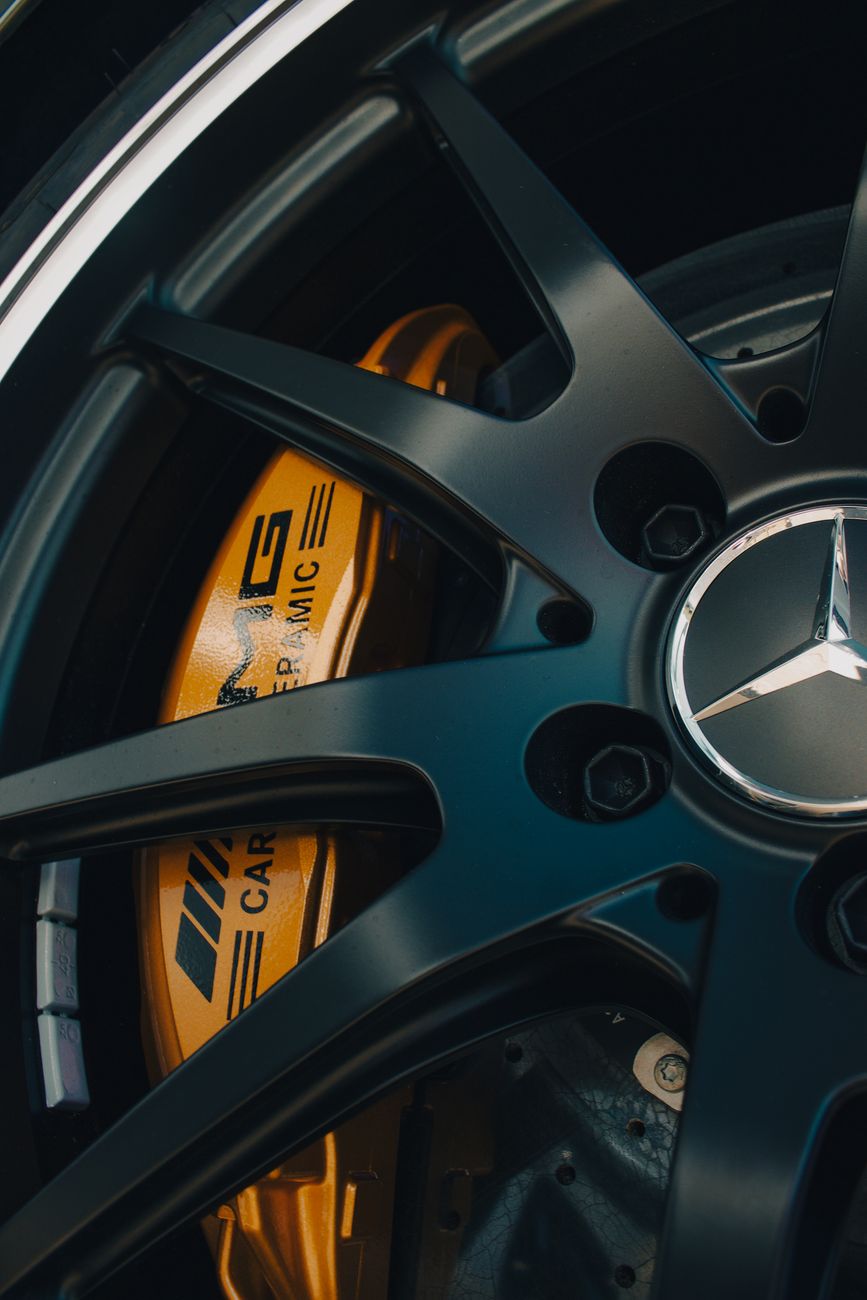
- Look through the wheel spokes and estimate pad thickness. As a rough guide:
- 3 mm or less: plan replacement soon
- 1–2 mm: replace immediately
- Compare left vs right on the same axle. Big differences suggest sticking hardware.
Wheel-off inspection (better, but requires confidence)
If you can safely jack the car and support it on axle stands:
- Check inner and outer pad thickness (inner often wears faster if sliders stick).
- Inspect discs for:
- Heavy lip at the edge
- Deep grooves
- Blue spots (overheating)
- Check caliper slider boots for tears and signs of rust.
Warning lights and electronic checks
On the W205, brake pad warnings are often triggered by the wear sensor circuit. Once the sensor has worn through, it must be replaced (you can’t “reset” a physically worn sensor).
- A workshop can confirm fault codes and status using Xentry.
- If you also own other marques: BMW uses ISTA, VW/Audi uses ODIS, and JLR uses Pathfinder/SDD—the concept is the same: confirm which axle has triggered and rule out wiring faults.
Quick road test clues (use caution)
- A hot smell or one wheel noticeably hotter after a normal drive can indicate dragging brakes.
- Pulsation through the pedal suggests disc runout or uneven disc thickness.
5. How to fix
Decide what to replace: pads only or pads + discs?
- Pads only can be fine if discs are within spec, smooth, and not heavily lipped.
- Pads + discs is often the best-value choice when discs are near minimum thickness or have vibration/grooving.
Parts choices that work well
- Choose quality pads (OE or reputable brands). For many W205 variants, common OE suppliers include ATE, TRW, Textar, Brembo (availability varies by market).
- Replace:
- Wear sensor(s) on the axle being serviced (if fitted and triggered)
- Pad fitting hardware (springs/clips) if corroded or deformed
Rear brakes with EPB: service mode matters
Many W205 rear calipers are linked to an electronic parking brake. For these:
- Put the EPB into service/maintenance mode before pushing back pistons.
- A workshop will typically do this via Xentry, ensuring the actuators retract properly.
- For DIYers, forcing the piston without correct procedure risks damaging the mechanism or triggering faults.
Installation basics (what good workshops do)
- Clean hub and caliper carrier contact points so pads move freely.
- Lubricate slider pins with the correct brake grease (not copper grease on rubber boots).
- Torque bolts to specification (critical on caliper carrier bolts).
- Check brake fluid level before and after pushing pistons back (avoid overflow).
- After fitting, pump the brake pedal until firm before moving the car.
Bedding-in (often ignored)
New pads need a controlled bed-in to transfer an even layer onto the disc:
- Perform several gentle-to-moderate stops from 50–20 km/h, allowing cooling between.
- Avoid heavy emergency stops for the first 200–300 km unless necessary. Poor bedding is a common cause of squeal and “warped disc” complaints.
6. Repair costs
Costs vary by engine, brake size, and whether you replace discs too. As a realistic European range (parts + labour):
- Front pads only: €180–€350
- Rear pads only (with EPB): €200–€380
- Front pads + discs: €350–€750
- Rear pads + discs: €380–€800
- Wear sensor (if separate line item): €15–€45 parts, €0–€40 labour (often included)
Main dealer pricing can be higher, while independent Mercedes specialists may sit mid-range. If you have performance brakes or larger AMG-style setups, expect the upper end or beyond.
7. Prevention tips
- Brake smoothly and anticipate traffic to reduce unnecessary braking.
- Rinse brake dust in winter to reduce corrosion (avoid spraying ice-cold water on hot brakes).
- Service caliper sliders when pads are changed—this is a small step that prevents uneven wear.
- Change brake fluid on schedule (typically every 2 years) to maintain consistent braking under heat.
- If you store the car, avoid leaving the EPB clamped for long periods in damp conditions—use wheel chocks when safe and appropriate.
8. When to see a mechanic
Book a professional if any of the following apply:
- You hear grinding, or braking performance suddenly worsens.
- The car pulls to one side, or a wheel is noticeably hotter (possible sticking caliper).
- You have an EPB and you’re not confident using the correct service mode procedure.
- The brake warning persists after replacement—needs code checks and wiring inspection (typically via Xentry).
- You feel vibration under braking; the discs may need measurement for runout and thickness variation.
Brakes are not the place for guesswork. A good independent specialist with the right tools can often match dealer-quality work at a lower price.
9. Frequently Asked Questions
Frequently Asked Questions
Can I replace only the brake pads on my Mercedes C-Class (W205) without changing the discs?
Yes, if the discs are smooth, not heavily lipped, and still above minimum thickness. If you have vibration, deep grooves, or the discs are close to the wear limit, replacing discs and pads together usually gives better results and avoids repeat labour.
Why did my brake pad warning stay on after changing the pads?
If the wear sensor was triggered, it usually needs replacement because the circuit has been physically worn through. A damaged sensor wire or connector can also keep the warning active. A quick scan with Xentry can confirm which axle and circuit is reporting the fault.
Do I need to put the electronic parking brake into service mode for rear pads?
On many W205 variants, yes, because the rear calipers integrate with the EPB system. Retracting the piston without the correct procedure can damage the actuator or cause fault messages. A workshop will typically handle this via Xentry as part of the brake service.
What causes uneven brake pad wear left-to-right on the same axle?
Common causes include sticking slider pins, corrosion on pad contact points, or a caliper piston that doesn’t retract cleanly. Uneven wear should be investigated because it can overheat the brakes and reduce stability under hard braking. Fixing the underlying caliper hardware is as important as fitting new pads.
How long should new brake pads last on a W205?
It depends heavily on driving conditions, but many owners see 25,000–60,000 km from a set of pads. City driving, hills, and heavy loads shorten life, while motorway driving extends it. The best indicator is regular visual checks and responding promptly to wear warnings.